The Role of Mobile Apps in Public Administration
of Disaster Relief
by Peter Lyn René -
Published on PA Times -
April 15, 2016
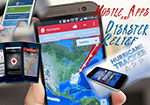
Mobile apps are now taken for granted in our society, not because they are
unimportant but because they are plentiful and readily available. When we
download apps from the Android’s Play Store or Apple’s App Store, it is a
relative mundane task. We search for free apps or pay for an app to help us
remain organized, stay in shape, meet our deadlines, check our bank balance
or remind us, remind us, remind us. Thanks to this wonderful era of mobile
technology, there is an app for practically everything needed to make our
lives an absolute joy.
But apps are not just relegated to bring
laughs, joy or structure to our lives. They can also be practical, necessary
and life-saving. In the last five years, we have witnessed a paradigm shift
in emergency management by which the reliance of “brick and mortar”
procedures—such as telephones, computers, ships, planes and vehicles used to
assist in disaster relief—are now nicely complemented with mobile apps
specifically designed for disaster relief. One technological marvel should
not be left out of the conversation: the use of unmanned automated vehicles
(UAVs), better known as drones.
When discussing emergency management, it can be divided into two parts:
disaster preparedness and the actual disaster. Nowhere more than the
Caribbean region is disaster preparedness an essential practice. Natural
disasters, such as hurricanes and tropical storms, will batter nations.
One of the best apps according to CNN is Hurricane Tracker.
This
app includes live video briefings on hurricanes, real time condition
updates, push alerts, dozens of maps and minute-by-minute updates. This app
also has access to the
NOAA weather
radio, complete with high resolution animation. Another app that focuses
specifically on the Atlantic, Caribbean and Gulf of Mexico region is
Hurricane Express. Like Hurricane Tracker, it provides forecasts, video
updates and satellite imagery with information from The National Hurricane
Center. In a
study by Paul Cerrato and Iltifat Husain, M.D., the
Red Cross Apps were identified as the group with the most useful
applications for natural disasters. Dr. Husain indicated that with the
advancements in social media and a surge in the prevalence of smartphones,
we are now seeing live Twitter and Facebook updates and emergency-related
applications being used in disaster response efforts. Perhaps one of the
best apps to assist in emergency management is the
FEMA app. It includes an
interactive emergency kit list, emergency meeting locations that can be
stored and a map of open shelters. This free app provides a feature that
lets users create Global Positioning System photo reports that can be
inserted in a map for others to see.
At the
ninth Caribbean Conference on Comprehensive Disaster Management, hosted
by the Caribbean Disaster Emergency Management Agency (CDEMA) and the
Bahamas’ National Emergency Management Agency (NEMA) in November 2015, the
Red Cross Apps were the leading instrument discussed, promoted and
supported. The Bahamas Red Cross, through their Resilience in The Americas
(RITA) program, has a multihazard smartphone app which features information
on natural hazards, basic first aid procedures and emergency messaging,
including location, emergency lights and sound. This app was well-received
and viewed as useful to the natural disaster-prone Caribbean.
Not to
be outdone by mobile apps, responding to and executing disaster relief just
got easier thanks to drones that are patiently waiting their turn to be
officially called up to assist first responders.
CNN’s Heather Kelly indicated as far back as 2013 that these portable,
affordable aircraft can launch quickly in dangerous situations, locate
survivors and send data about their whereabouts to responders on the ground.
The UAV industry and emergency responders are preparing for the day when
they can launch drones after tornadoes, earthquakes, hurricanes, floods and
any other disaster.
Challenges to emergency management and public policy have changed and
continue to change to stay in step with technological advances. Gone are the
days when disaster relief meant supply ships and military assessments and
where areas devastated by natural disasters remained technologically cut off
from the rest of the world. The smartphone, in its many forms, has proven
itself to be a powerful tool in emergency management and the use of drones
continues to grow.
Emergency management agencies and other companies
have now developed hundreds of apps to assist individuals to be better
prepared for impending storms and hurricanes. These apps not only keep
emergency managers informed but also connected to efforts on the ground.
DeeDee Bennett exclaimed this is a
wonderful time to be in emergency management. The progression of
technology will forever change our vulnerability, preparedness, response,
recovery and resilience. The new use of drones, robots, smartphones and even
wearables during disasters will certainly spark more growth in the practice
of emergency management.
This article was published online on PA Times.
Link to this article.